On Saturday 25 March 2023, asteroid 2023 DZ2 — nicknamed “Dizzy” — made a close approach: a roughly stadium‑sized rock passed Earth at about half the Earth–Moon distance.
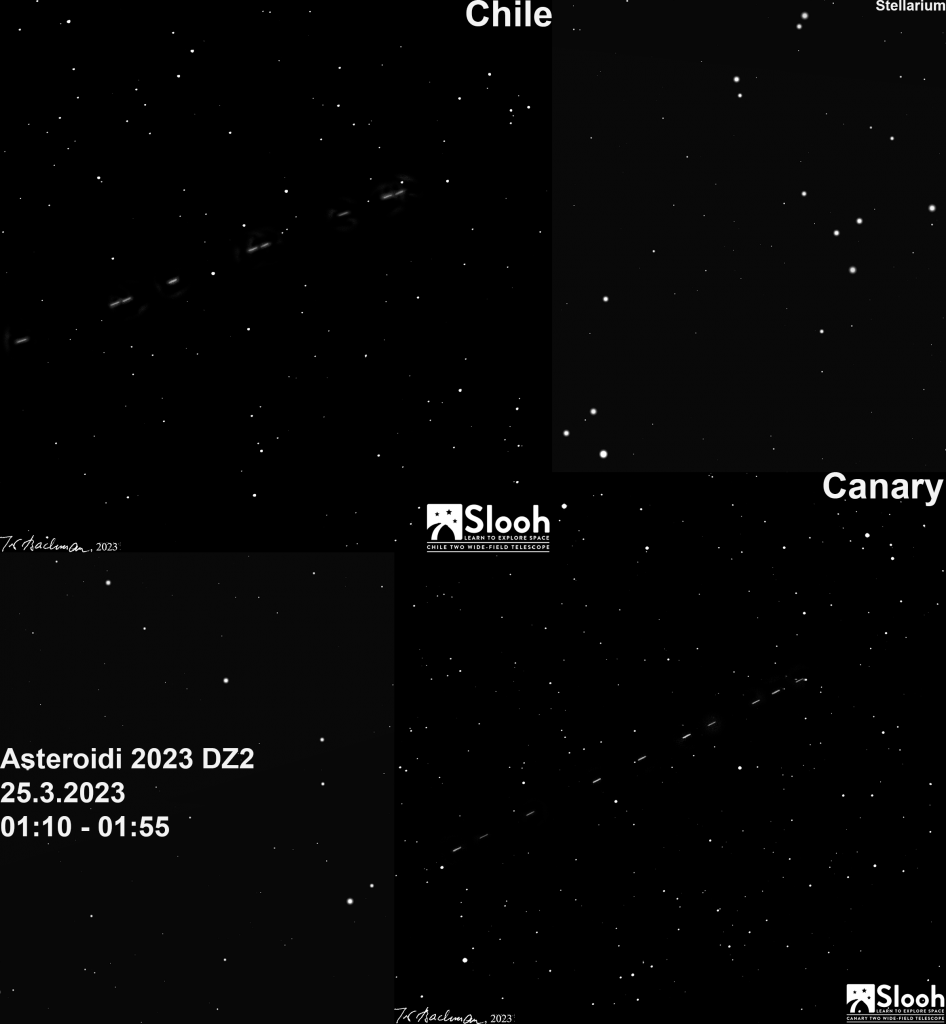
The asteroid orbits the Sun with a period of roughly three and a half years. Objects like this have close encounters on different cycles, depending on how their orbits line up.
Remote telescope images
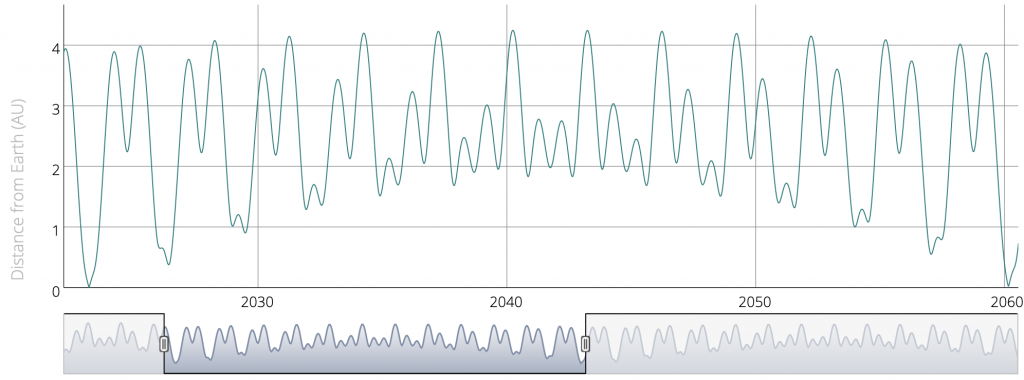
On Friday evening 24 March, Slooh arranged a special event for the night, offering multiple observing slots for this asteroid. I had prepared by computing the asteroid’s ephemeris in Stellarium — in practice, Dizzy moved clearly between frames.
Participants could download their selected observations and combine them into short image sequences. The images in this article were processed in PixInsight and Photoshop.
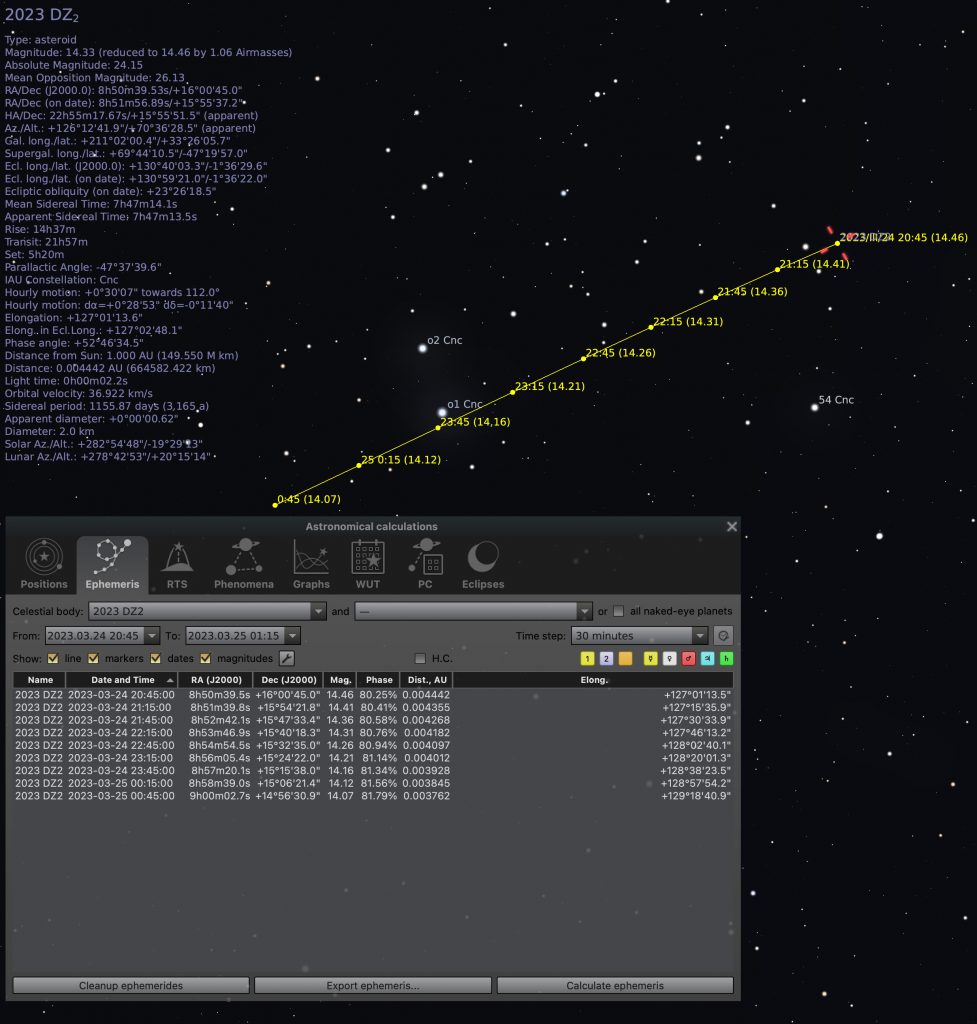
The “Telescope 1” on La Palma (Canary Islands) is a 0.5‑meter reflector. The event images were taken through three different filters, so in each observation the asteroid appears in red, green and blue. Because Dizzy was moving fast enough, the positions differ slightly between the colors.
Slooh also has a slightly smaller 432 mm telescope on the Canary Islands. Both Canary telescopes track equatorially: the star field stays fixed and the asteroid moves relative to the background.
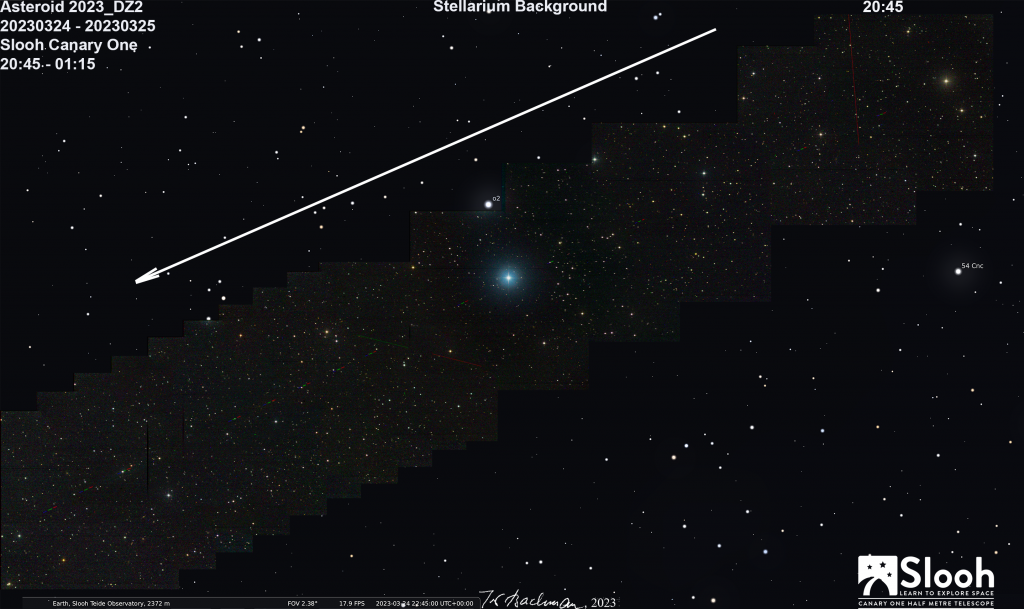
However, the stars looked different compared with the asteroid frames from Slooh’s Chilean observatory. At first I wondered if something had changed in the optics — but the explanation is simpler: the same star field looks slightly different from different observing sites due to parallax.
When I explored the situation in Stellarium, I noticed the target was not very far away. The telescopes are separated by about 10,000 km across Earth, so the parallax can be measurable. The telescopes’ field of view is about 43 arcminutes — so the effect can be visible.
And indeed, I found roughly a dozen matching stars in the lower corner of the Chile image. When I aligned the star patterns, I got the comparison below.
Dizzy’s distance from Earth
The asteroid itself doesn’t look spectacular in these frames, but a stadium‑sized body is still extremely far away. So: how far was it?
From the comparison image above we can make a rough estimate of the parallax. I measured the shift between the Chile and Canary images as 1585 pixels. The image field of view is 43 arcminutes, i.e. 2580 arcseconds. That gives about 1.63 arcseconds per pixel, so the measured shift corresponds to roughly 0.72 degrees? (No — arcseconds: 1585 × 1.63″ ≈ 2584″ ≈ 0.718°). This is a back‑of‑the‑envelope estimate, but it gives the right order of magnitude.
The parallax calculation uses a right triangle: one leg is the baseline (the distance between observing sites), the other leg is the distance to the object, and the angle between the legs is the parallax angle. From that, the distance is approximately baseline / tan(parallax).
TheSkyLive provides an interactive sky map with a distance readout. At closest approach the distance was about 490,000 km. My estimate gave about 530,000 km, so the error was roughly 8% — not bad for such a simple measurement.