What is a conjunction?
At the turn of February to March, Jupiter and Venus formed a beautiful conjunction in the evening sky. On the closest nights the planets were only about the width of the Moon’s apparent diameter apart.
In a conjunction, two objects appear close together in the sky as seen from Earth. Of course, the planets are not physically close to each other — the effect is purely a line‑of‑sight geometry. Because the planets orbit in nearly the same plane (the ecliptic), conjunctions between bright planets are fairly common, but a particularly close and photogenic pairing is always worth stepping outside for.
Observations
Here in South Karelia we were lucky with clear skies, so I followed the approach of the planets on two evenings before the closest encounter.
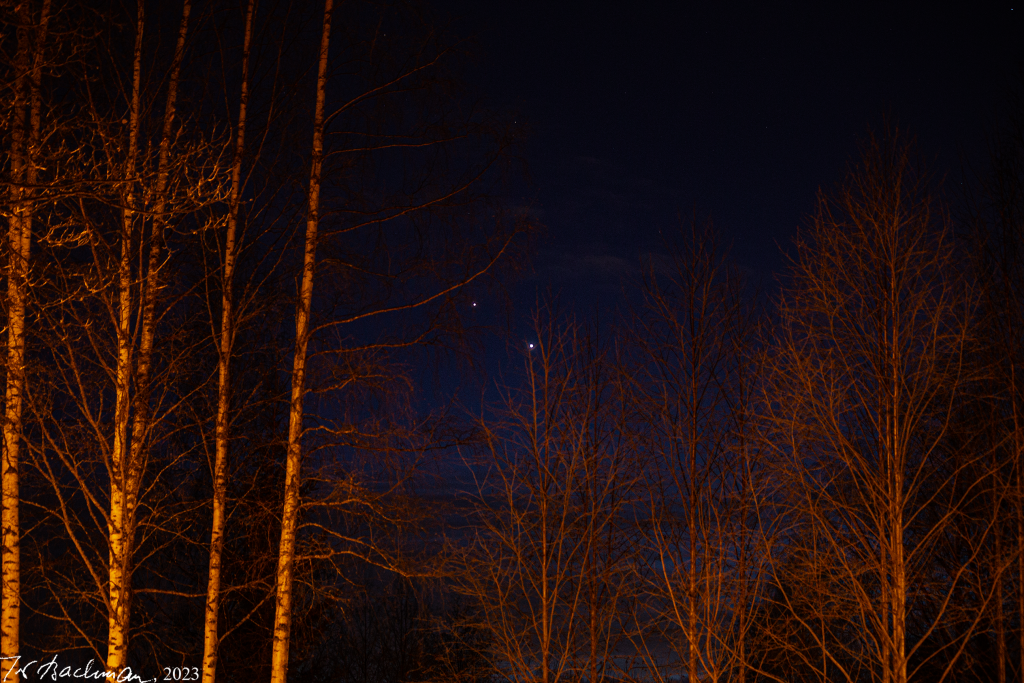
In the image Jupiter is on the left and Venus on the right. The brightness difference is obvious even when the two are close together: Venus outshines Jupiter by a wide margin. (Astronomical magnitude is “backwards”: smaller or even negative values mean a brighter object.)
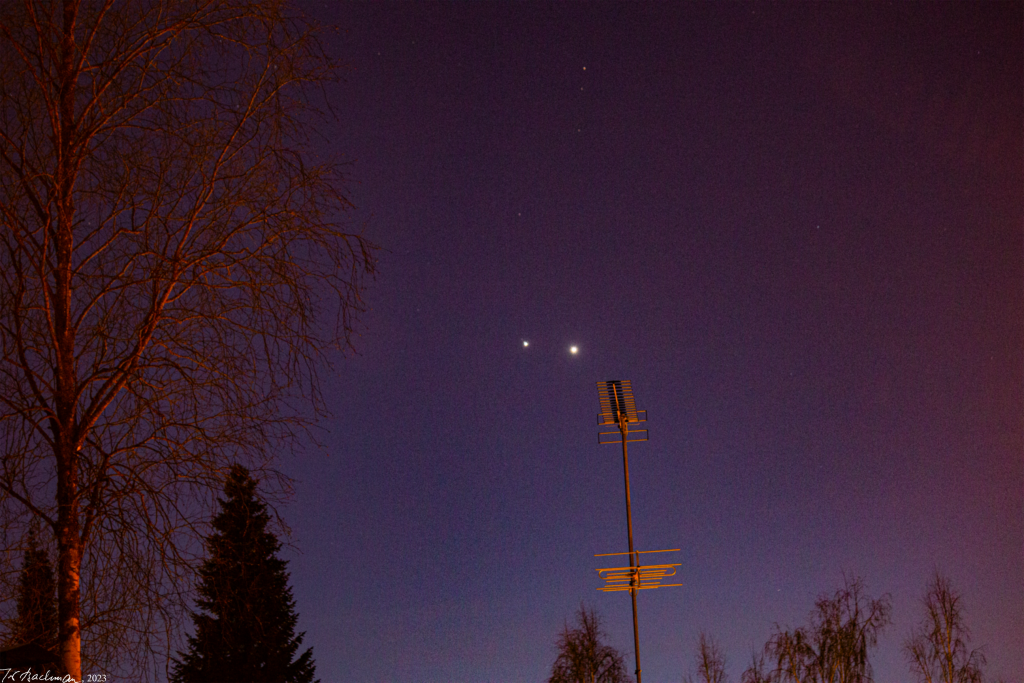
Now the planets were not only closer together but also at nearly the same altitude above the horizon. The air was steady and the transparency was good. With a Bahtinov mask to assist focusing, the result was pleasantly sharp for such a “grab‑and‑shoot” setup.
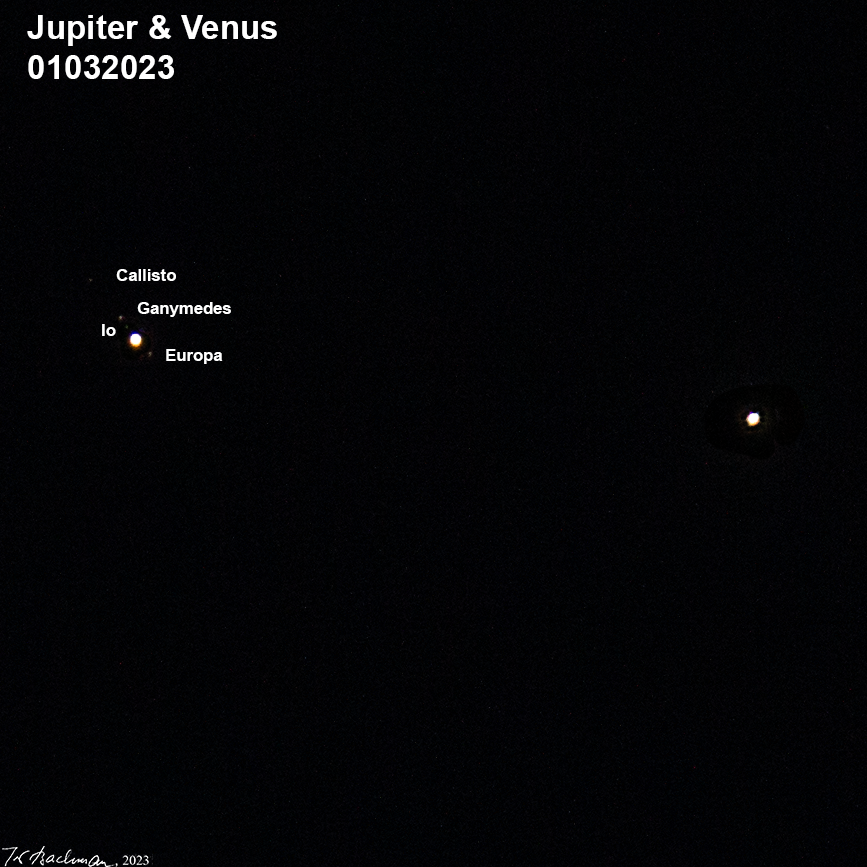
The planets were closest on the morning of 2 March. By the evening the separation had already started to grow again, but the view was still excellent. Unfortunately, I personally didn’t manage to photograph the very closest moment.
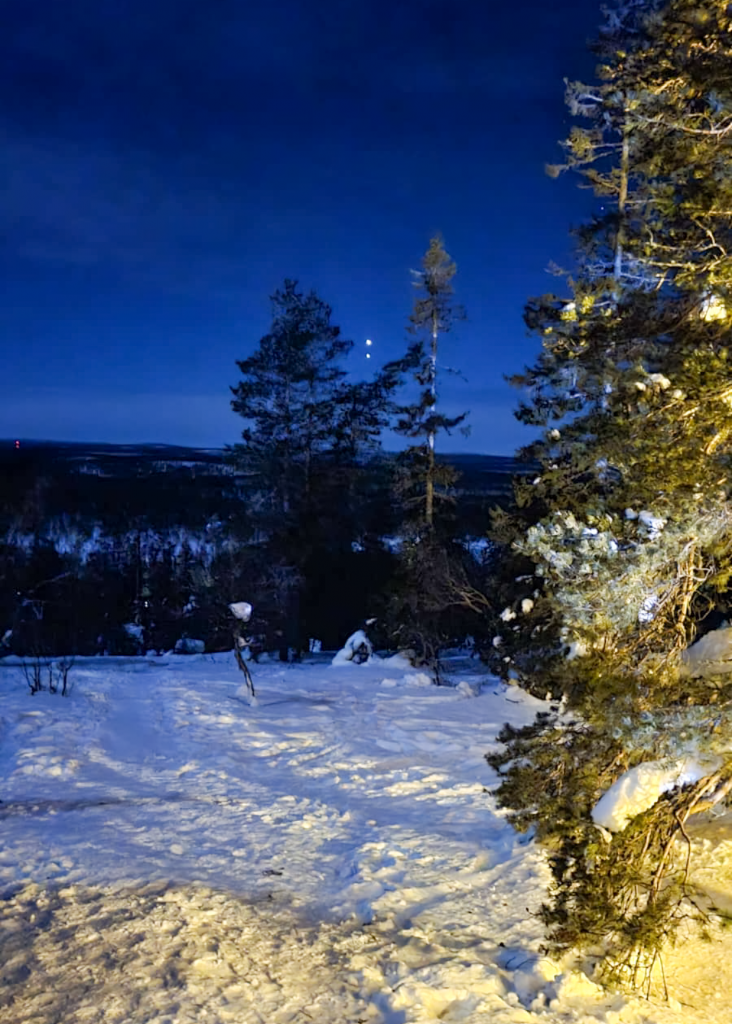
In this last image Venus has already climbed above Jupiter. Even in a short time the mutual orientation of the planets changes because the sky “rotates” during the evening and the planets continue their own motion along the ecliptic.
Conjunctions like this are a great reminder that the sky is not static — and that even a simple phone camera can capture memorable astronomical events when the timing and weather cooperate.
Why do planetary distances change
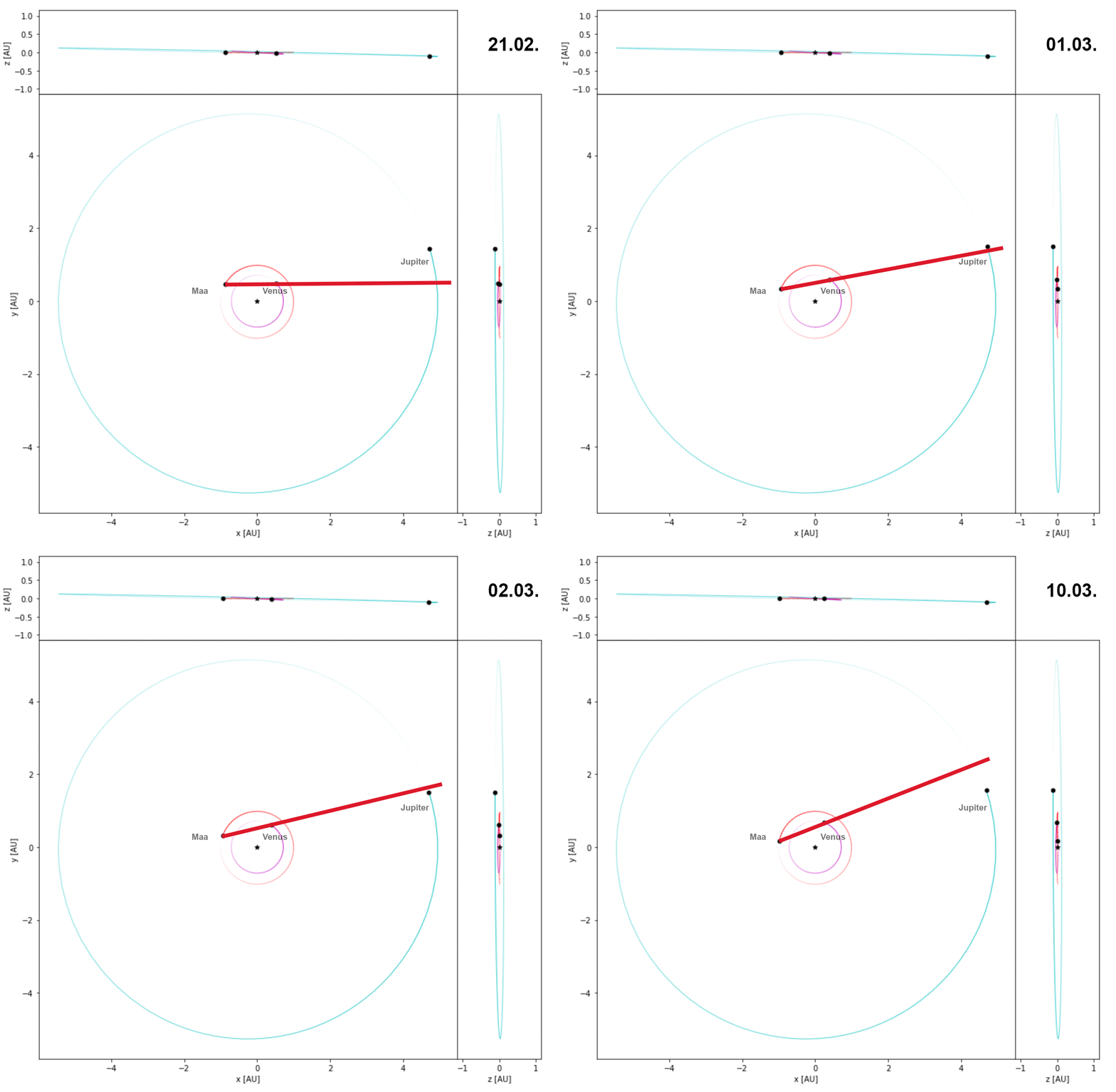
The following simulation shows the relative positions of the sun, earth, Venus and Jupiter (not to scale, especially with respect to the sun). A red line of sight has been drawn from the earth to indicate the relative positions of Venus and Jupiter. The simulation shows how, seen from the earth, Venus has time to travel a significantly longer distance compared to Jupiter in the same time.
The free Stellarium program allows you to survey the events in the starry sky using the coordinates of your home location (or any location) and also allows you to view the coordinate sets, or ephemerides, of objects at desired time periods.
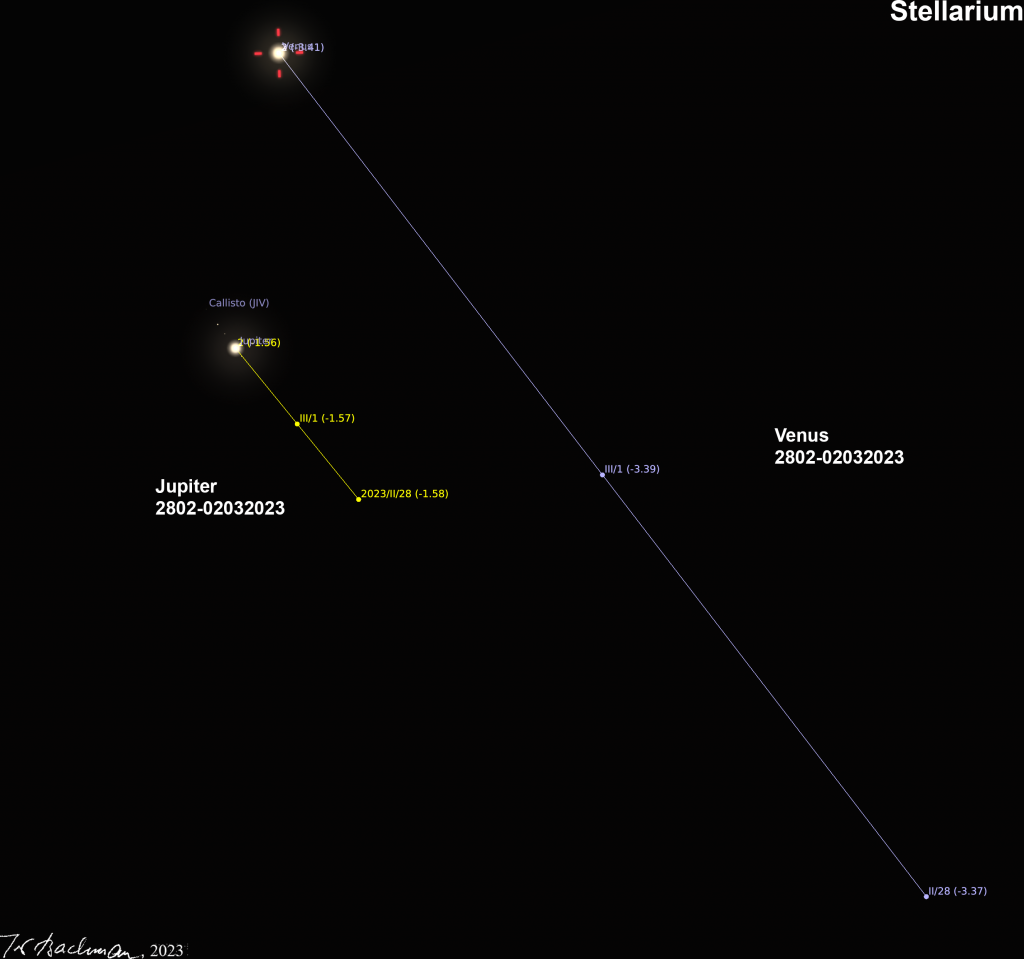
The image shows how Venus climbs above Jupiter after being clearly below it just two nights earlier. Stellarium can also conveniently measure the distances between the planets, which are marked in the observations.