Deep‑sky objects are faint and the details are subtle. The single exposures you get from a telescope are therefore noisy, and the target can look disappointingly weak. The key trick is stacking: combining many exposures so that real signal adds up while random noise averages out.
The practical question is: how many frames is “enough”? To illustrate this, I compared results where I stacked 1, 2, 4, 8 and more frames, and then looked at what actually improves in the final image.
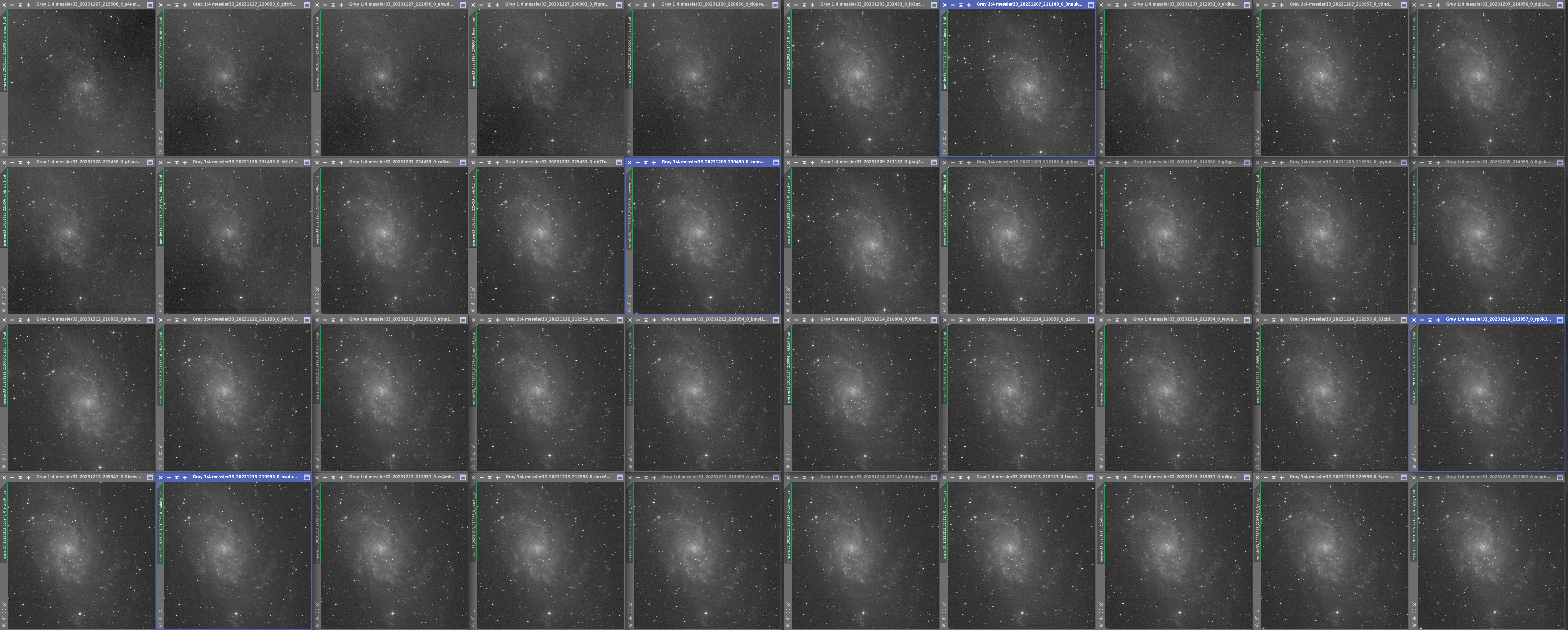
As a test target I used the Triangulum Galaxy (M33), located near the border of Triangulum with Pisces and Andromeda. Using a remote telescope (Slooh) also let me book extra “backup” sessions in case some frames failed — which turned out to be a good idea.
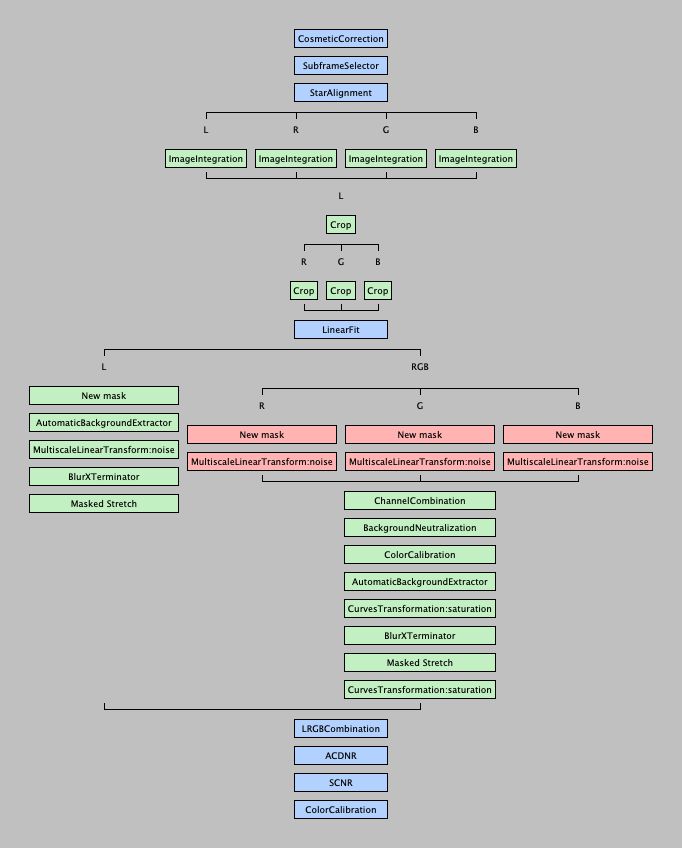
The field of view in these frames is about 43 arcminutes across, with a 1528 × 1528 pixel image. As always, the raw data contains unwanted components such as dust shadows, thermal and read noise, and amplifier glow.
Slooh’s image bank provides calibrated frames. Even so, not every exposure is usable: some frames had trailed stars, so the spare bookings were needed.
After downloading the frames, I processed them using PixInsight and Jarmo Ruuth’s AutoIntegrate workflow. The benefit of a scripted pipeline is repeatability: the same steps are applied consistently without human slips or forgotten settings.
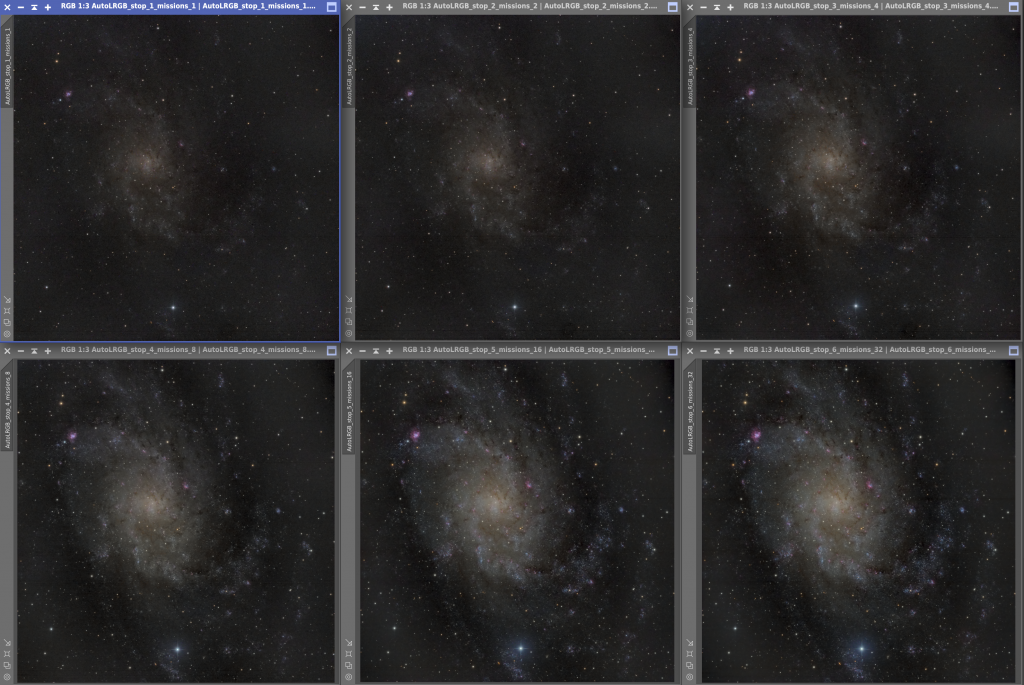
Below are three comparison images where the different stacking depths are shown side by side. I also include a simple zoom‑in to make it easier to compare the faint structures and noise texture.
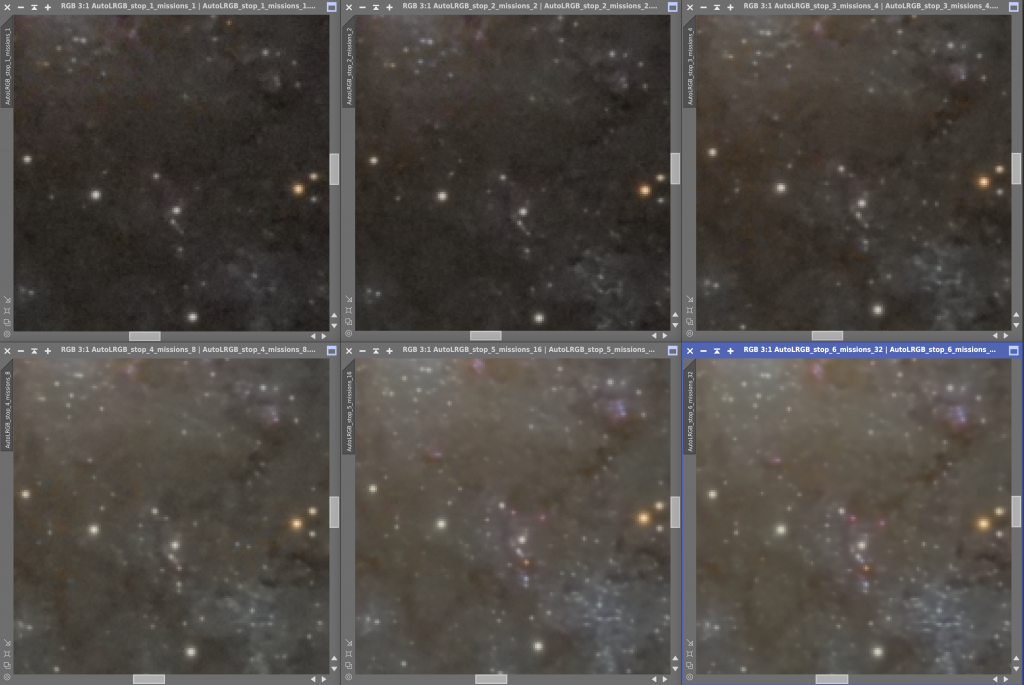
When zoomed in, you can see that smaller stackings really don't give you the same accuracy and the bottom row seems to contain significantly more data.
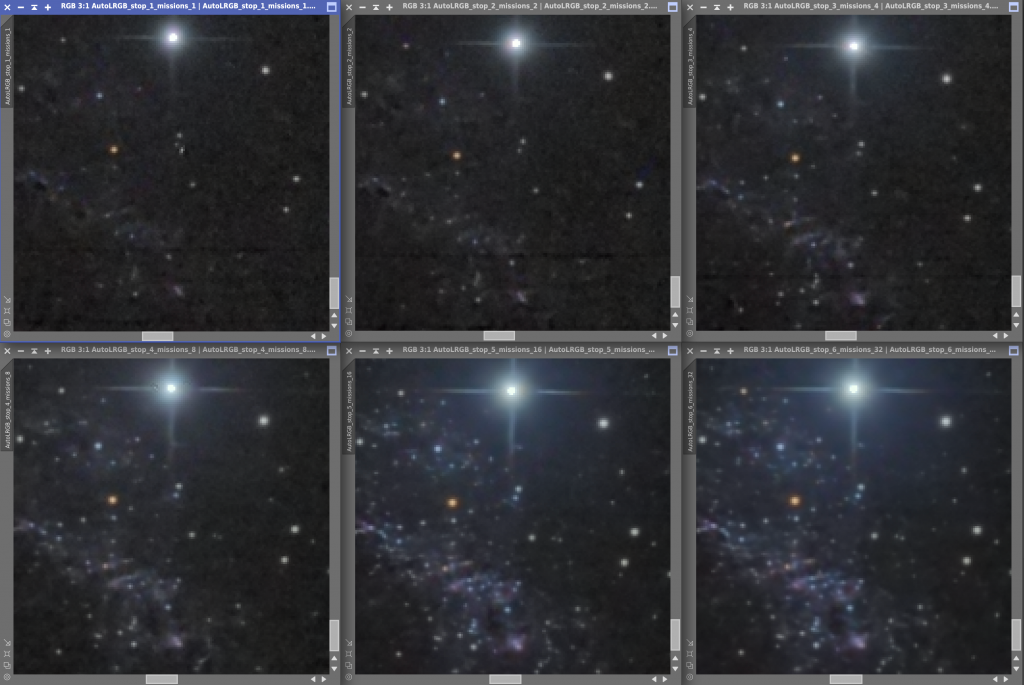
This magnification further confirms the point. On the other hand, the difference between 16 and 32 stacks is really negligible. Even 8 stacks give a good result.
Based on this test, I would say that four stacks are already enough, but 8 or 16 give a better result. It is likely that stacking 32 images will not significantly improve the final result.
I made the final image from that 32 image stack by further processing it in Pixinsight and Photoshop.
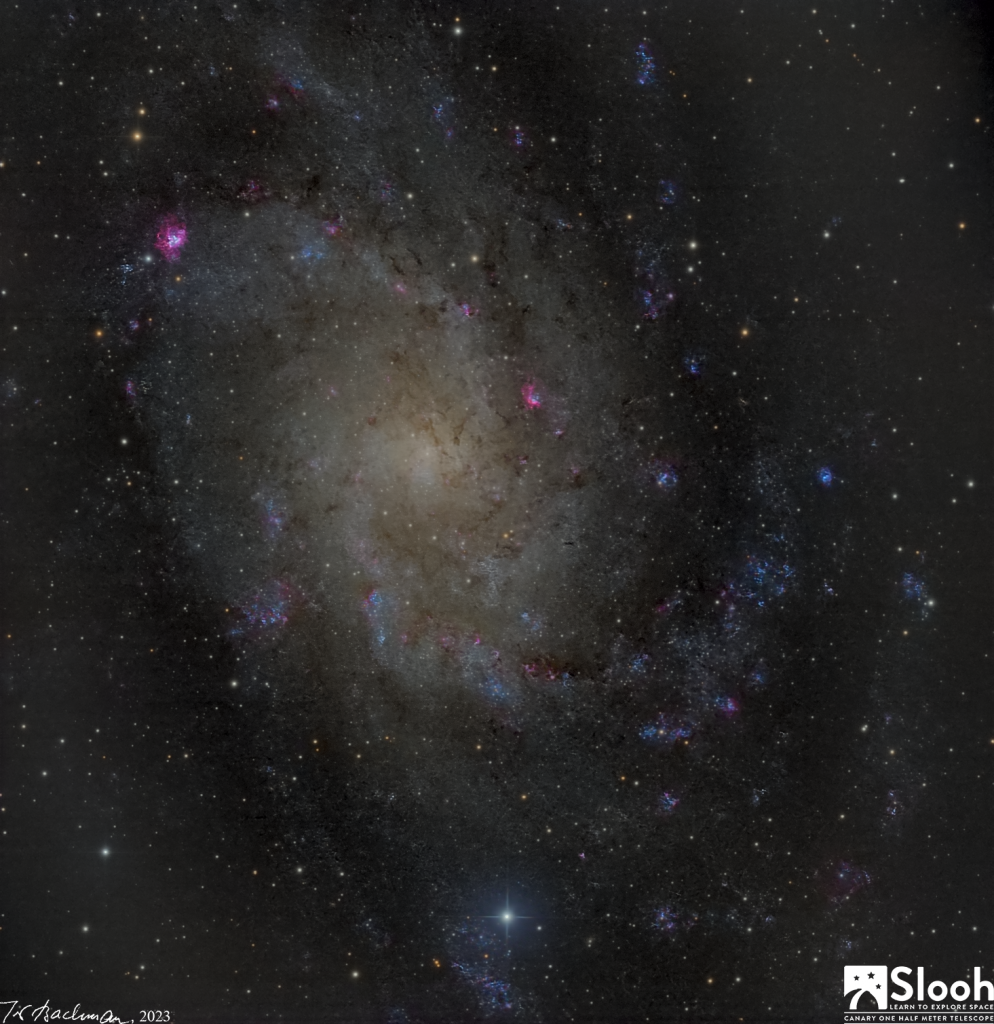
The image shows the galaxy's spiral arms and the brilliance of its center. Bright gas nebulae NGC 604 at the top left and NGC 595 in the center of the image stand out nicely. They get their colors from hydrogen ionized by new stars. NGC 604 is about 1,500 light-years across and 40 times larger than the Orion Nebula M42.
The bright 8th magnitude star HD 9438 at the bottom of the image is part of our own Milky Way galaxy, about 700 light-years away.