Prague Astronomical Clock
Years ago I first became fascinated by Prague’s Astronomical Clock after finding an Excel spreadsheet online that simulated and explained its operation. Later I also got to see the real clock twice in person, in 2010 and 2014.
The Prague Astronomical Clock (Orloj), mounted on the south wall of the Old Town Hall tower, is a medieval masterpiece that was in use no later than 1410. It is both a major attraction and a carefully designed “model of the universe”, where a single mechanism drives several displays at once. The clock has two main dials: the upper astronomical dial and the lower calendar dial.
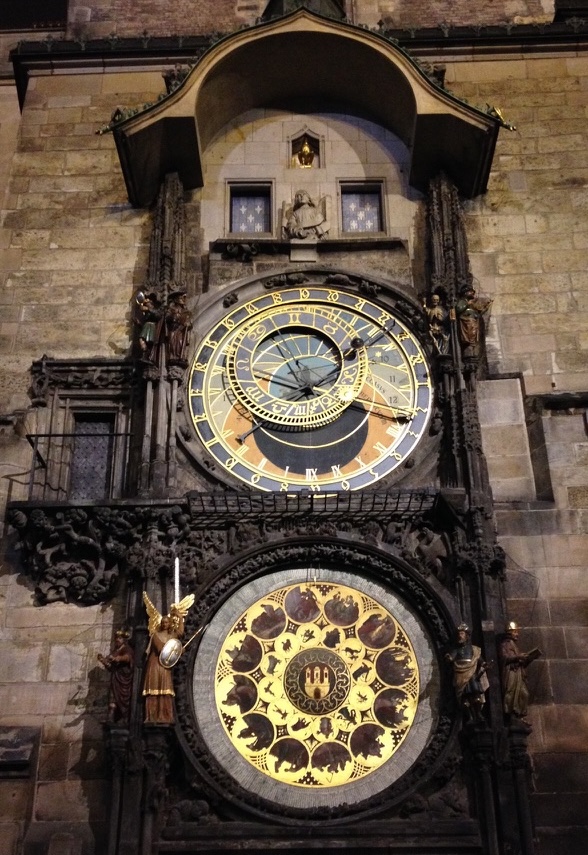
The astronomical dial works as a moving sky map. From it you can read the positions of the Sun and the Moon, see how they relate to the zodiac constellations, and also interpret the phases of the day (daylight, night, dawn and dusk) through the way the horizon and sky circles are drawn.
The idea is based on projecting the celestial sphere onto a plane (a stereographic projection), which makes it possible to draw the tropics, the equator and the horizon as concentric circles. One of the clock’s special features is its distinctive transmission: the zodiac ring, the Sun indicator and the Moon indicator are driven by large gear wheels built on the same axis, yet rotating independently.
On the celestial sphere, the horizon is the circle where our local horizontal plane cuts the sphere. On the astronomical dial it is shown as the boundary between the blue daytime area and the ochre twilight area (after 2018 renovation the night area is now red in color). The Sun rises in the east (left side of the dial) and culminates in the south (top of the dial). West is on the right, and north is at the bottom.
Stars form symbolic patterns—constellations. Many of them were named already in antiquity, and today 88 are officially recognized. For this clock the important constellations are those along which the Sun appears to move during the year. That apparent path is called the ecliptic.
Most ecliptic constellations are named after animals, which is why they are often called the zodiac. Traditionally the zodiac has twelve constellations, and during a year the Sun passes through each of them roughly once per month. On the clock, the ecliptic is marked by a ring showing the twelve zodiac symbols.
I also borrowed from my friend an excellent brochure about the Prague Astronomical Clock, which helped me describe the details more accurately. The close‑up images of the dial’s components in this article are taken from that brochure.
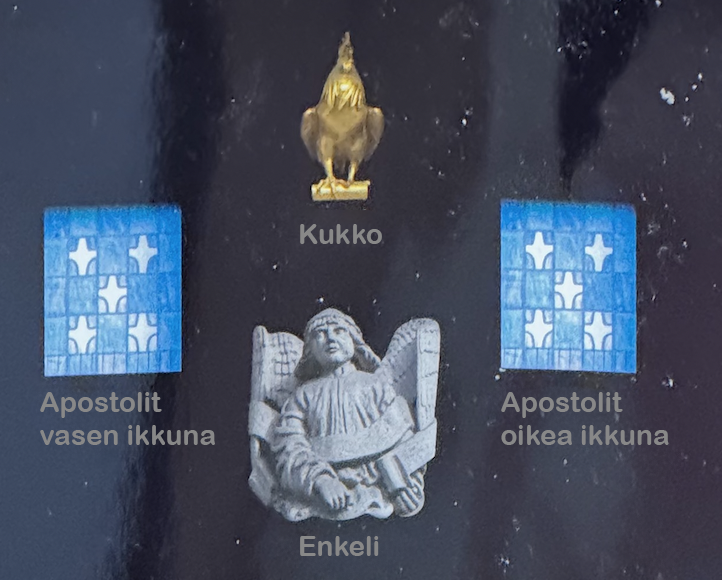
Above the clock faces, at the very top, is a gilded rooster, whose crowing signals the end of the hourly performance. Below the rooster is a stone bust of an angel, and in the windows on either side of the statue, carved wooden apostles move.
The astronomical dial
The upper, astronomical dial resembles an astrolabe, but it serves a different purpose. While browsing, I found a simulator that lets the clock run for any location—here I use Lappeenranta, Finland.
The clock shows several time scales in parallel. In the annotated image below they are marked with letters:
- Babylonian time: daylight divided into 12 variable “hours”
- Old Bohemian / Italian time: 24 hours counted from sunset
- Civil (German) time: modern equal hours
- Sidereal time: tied to the starry sky rather than the Sun
- The Moon’s motion and phase are shown with a separate indicator
- The zodiac ring helps visualize the Sun’s and Moon’s motion along the ecliptic
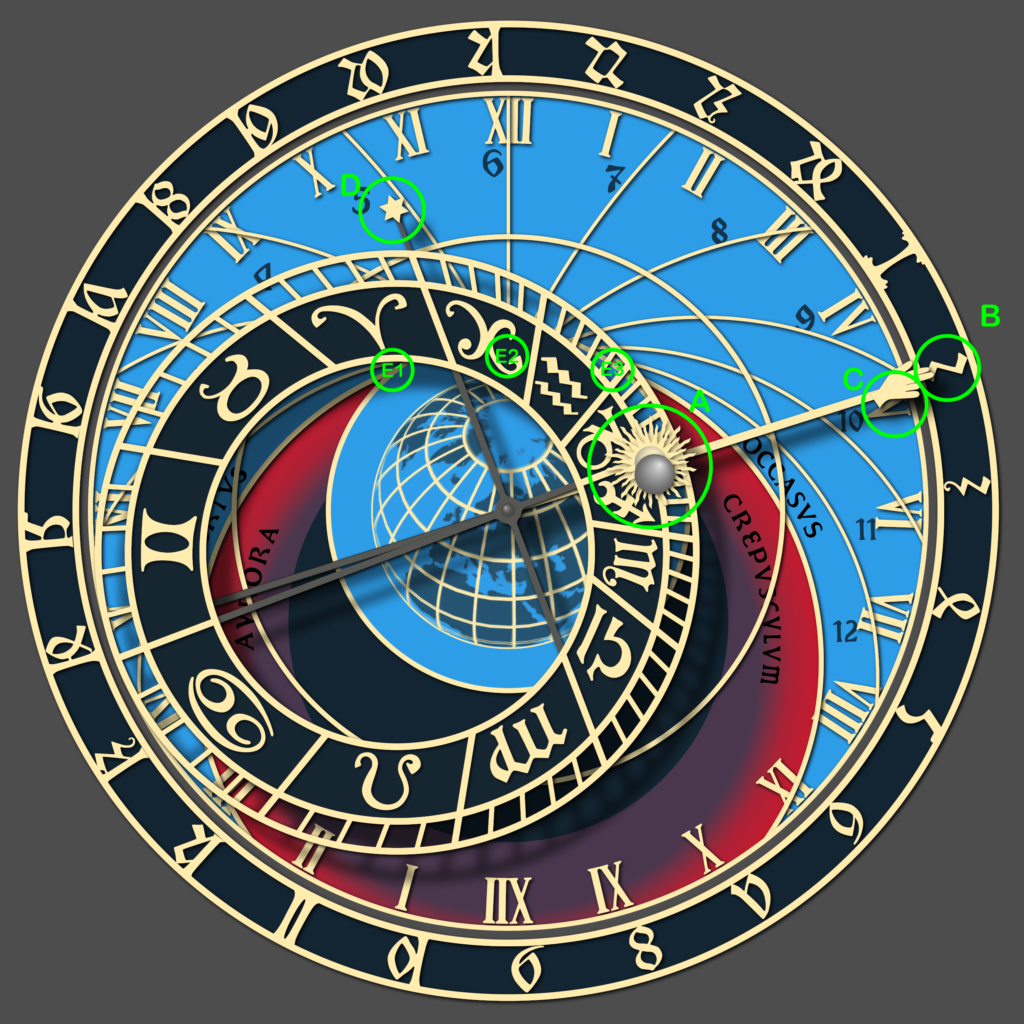
Babylonian time (A)
Babylonian time is historically the oldest time scale shown by the clock. The interval from sunrise to sunset is divided into twelve equal “hours”. Noon is at six o’clock on this scale, and the length of an hour changes with the seasons—especially at northern latitudes. A Babylonian hour equals our 60 minutes only near the equinoxes.
The Babylonian curves are drawn in gold in the blue field and numbered with dark blue Arabic numerals. The gilded Sun indicator points to them on the inner ring.
If you run the simulator faster, the clock advances day by day, and you can see the Sun indicator shifting up and down along the golden arm. This depicts the Sun’s annual motion between the Tropic of Cancer and the Tropic of Capricorn. Because the horizon is curved appropriately on the dial, summer nights begin later—so the hand travels farther along the outer ring than it does in winter.
In the example shown we are close to new Moon, so the Moon indicator on the zodiac ring covers the Sun. We can already see the Sun on the red, night region—so this “time” is not separately readable at that moment.
Bohemian time (B)
In the Middle Ages, old Bohemian time was used. The day has 24 hours counted from sunset. These early‑Bohemian hours are shown on the outermost ring with gilded Gothic Arabic numerals, and read by the gilded “human hand”. In the screenshot, the Bohemian time is ten minutes to two.
Two numerals look especially unfamiliar: the 4 resembles the Greek capital omega (Ω), and the 7 resembles a handwritten lowercase “a”.
Civil time (C)
Civil time belongs to the modern era. The day is measured twice from midnight, divided into twelve equal hours each time. It is also read by the gilded “human hand”, pointing to gilded Roman numerals. The clock shows a little before 5 p.m.
Sidereal time (D)
This is the only scale on the clock that follows the stars rather than the Sun. A sidereal day has 24 equal hours and is measured from the culmination of the vernal equinox point. A sidereal day is about four minutes shorter than a solar day. It is indicated by a small gilded star and read against the gilded Roman numerals. In the example it is about 22:30.
The Moon
The Moon has its own motion in the sky. On the astronomical dial it moves along the ecliptic, like the Sun. Over about 29 days and 13 hours it goes through all phases. Full Moon occurs when it is opposite the Sun; at new Moon the Moon and Sun are aligned—as shown here. Relative to the stars, however, the Moon moves faster, and its full cycle takes about 27 days and 8 hours.
This is why, on the clock, the Moon seems to move in the opposite direction compared with the zodiac ring and the Sun. With the simulator this is easy to see.
The Moon indicator also shows the phase (new Moon, first quarter, full Moon and last quarter). Here we are less than a day from new Moon, so it appears completely dark. The phase rotation is implemented by internal mechanics.
Zodiac ring (E1–E3)
The ecliptic ring rotates clockwise and off‑center. The radial supports also divide the zodiac into four seasons. Using the horizon and noon marker you can identify:
- Aries crossing the horizon on the dawn side—rising sign (E1)
- Pisces pointing at the Roman numeral XII (noon)—culminating (E2)
- Aquarius crossing the horizon on the dusk side—setting sign (E3)
The side figures
On the sides of the astronomical dial there are four figures that come alive on the hour.
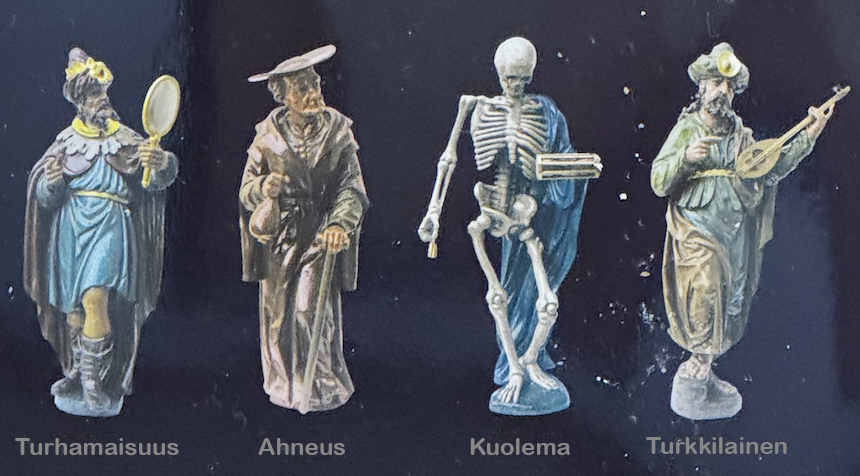
On the left, Vanity gazes into a mirror, and Greed shakes a money bag, refusing to leave this world. On the right is Death, who rings a bell and counts the days with an hourglass. Beside Death stands the Turk holding a lute.
The calendar dial
The calendar dial may look more subdued, but for a careful observer it actually tells something about every day of the year.
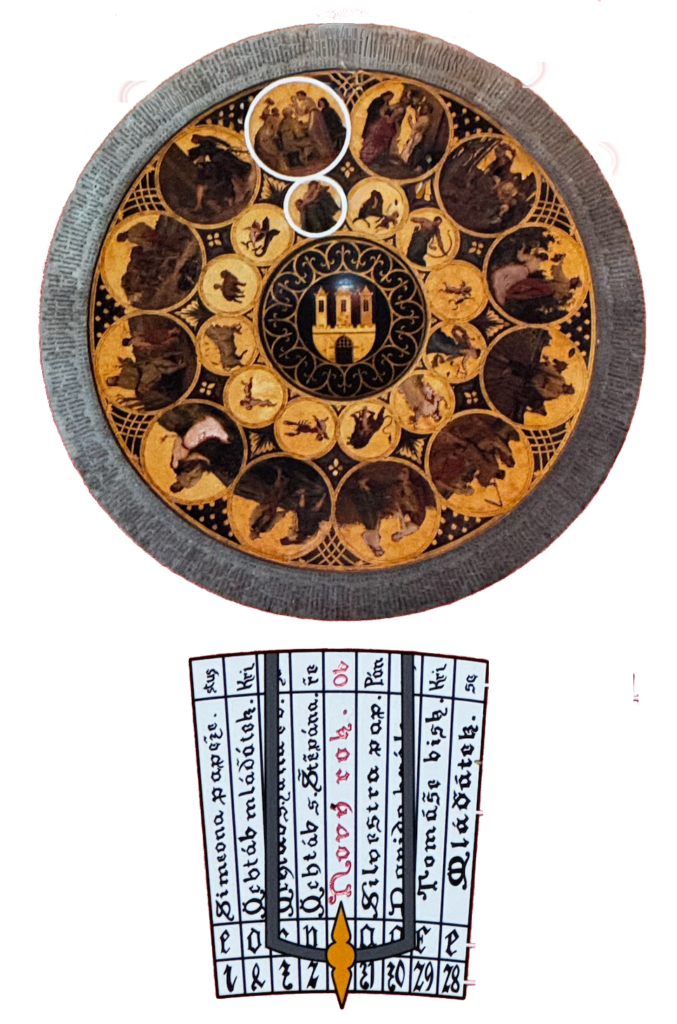
From the inside outward it contains six rings:
- A symbolic zodiac sign
- A symbolic month motif
- The running day of the month
- Weekdays A–G
- Feast days; those dedicated to certain saints in red
- A 12‑line mnemonic verse around the rim, helping remember the reason for each feast day
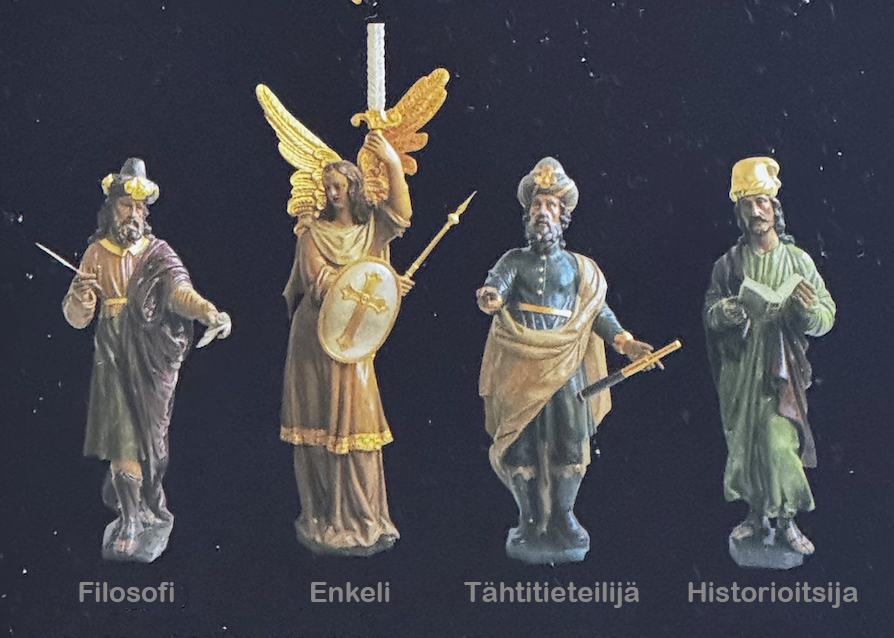
Around the calendar dial there are four stationary figures. On the left: a Philosopher with quill and parchment, and an Angel with a flaming sword as a symbol of justice. On the right: an Astronomer with a telescope, and a Chronicler with a book.
The mechanism
On YouTube I found a video titled Discovering Prague’s famous Astronomical Clock that also presents the mechanism. The oldest parts date back to the 1300s, while the newest components came with the 2018 overhaul.
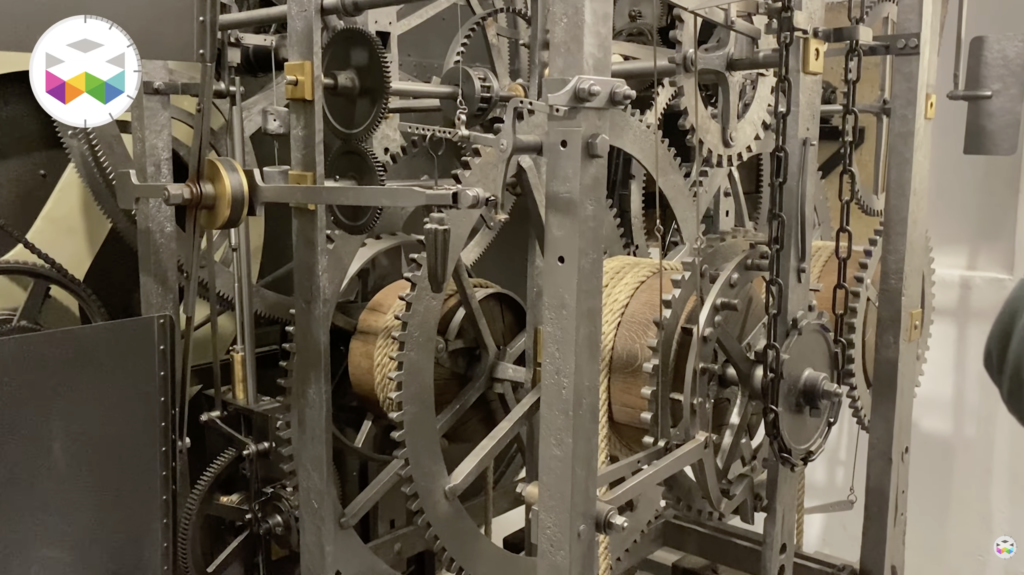
The mechanism consists of metal gears, springs, bolts and nuts, as well as wooden drums, ropes and weights.
Closing thoughts
It is remarkable that we still have, fully functional, a clock mechanism that traces back some 600 years—drawing a crowd on the hour to watch the show.
The clock has certainly been marketed well, but understanding it—even for well‑educated modern visitors—has not been made easy. Otherwise it would not have been nominated on lists of the “greatest tourist disappointments of all time”.
Perhaps the problem is the buildup: waiting for the hourly performance raises expectations, and in the end one only sees small motions here and there—no fireworks, and no musical performance.