The Large Magellanic Cloud (LMC) is the Milky Way’s largest companion galaxy — but from Finland it is completely unobservable. It lies far in the southern sky, and even from southern Europe it stays too low.
The LMC is a small irregular galaxy at a distance of about 160,000–170,000 light‑years. From the southern hemisphere it is an obvious naked‑eye object: a faint “cloud” that spans a surprisingly large area of sky.
That large apparent size is exactly what makes it challenging for imaging: the LMC is broad, and capturing it with good detail requires a mosaic. In angular size it is roughly 10° across — about eight Moon (or Sun) diameters.
There are several good tools for planning mosaics, but I have used Jarmo Ruuth's great AstroMosaic tool the most because it also includes parameters for Slooh’s telescopes.
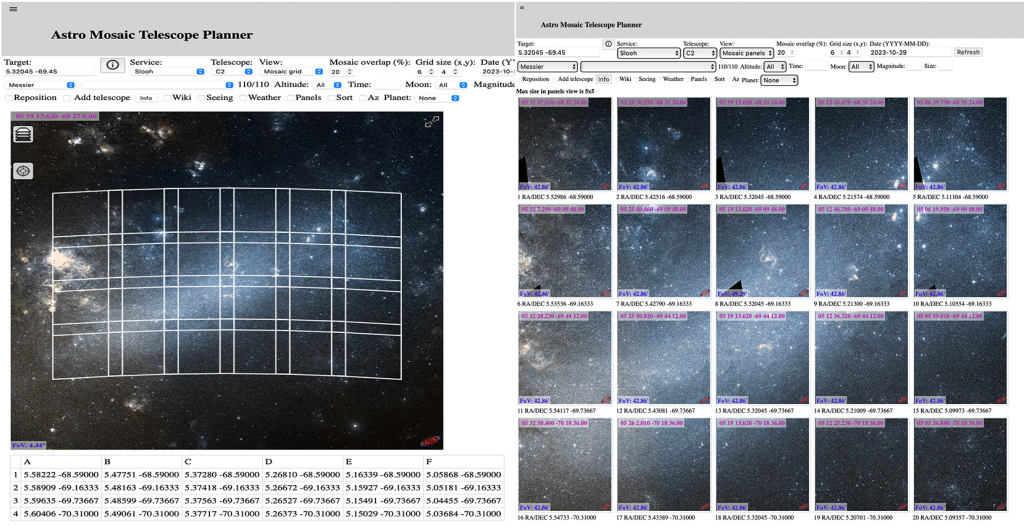
First, I checked the approximate center coordinates of the LMC in Stellarium (right ascension and declination). Then I used Telescopius to choose a framing that also includes the Tarantula Nebula near the edge — that gives the final image more character.
In hindsight it would have been better to start the project about half a year earlier. At the time of my campaign the LMC was already moving toward a poorer season (lower culmination and shorter nights), which slowed progress.
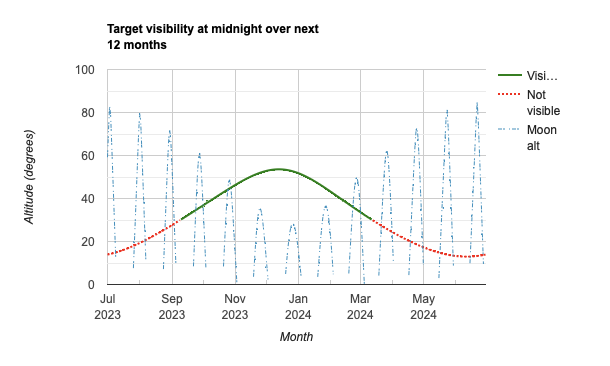
As a rule of thumb, it helps if the target reaches at least 50° altitude. Lower than that, atmospheric effects quickly degrade star quality and contrast. Fortunately, late at night the LMC rose to my minimum acceptable altitude.
Weather was the other main bottleneck. During that part of the year, clouds coming off the ocean repeatedly cancelled imaging nights.
I wanted to image each mosaic panel three times to enable stacking and noise reduction. With 24 panels that means 72 imaging runs — close to 300 individual sub‑frames in total.
Processing was done in PixInsight, using Jarmo Ruuth’s AutoIntegrate pipeline to produce initial results panel by panel. After that I refined the backgrounds so that all panels match before assembling the final mosaic.
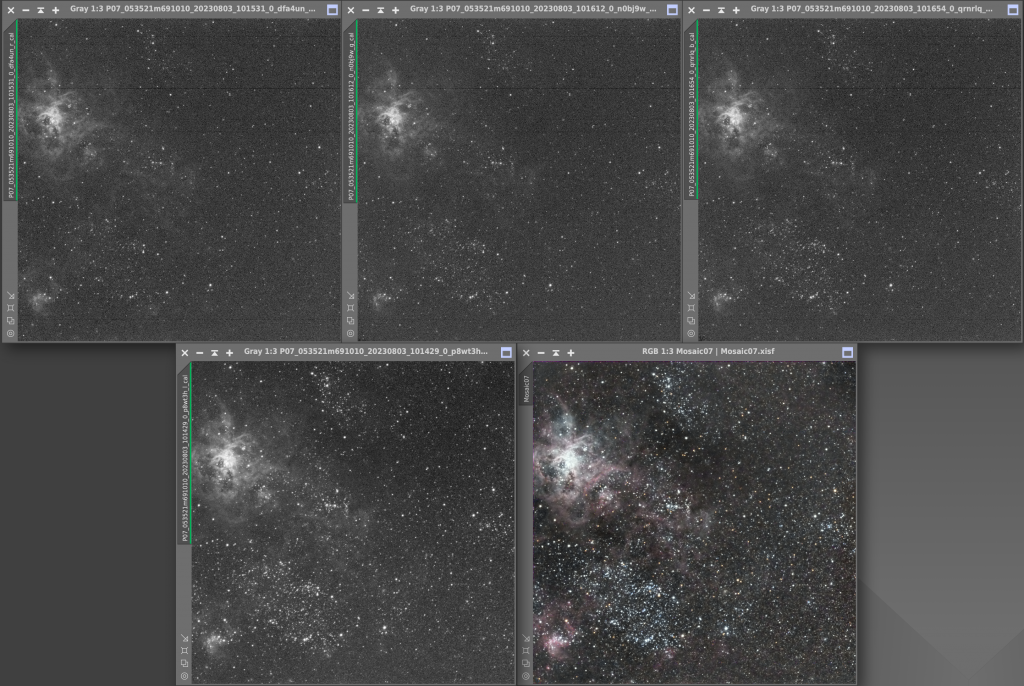
One panel (the seventh in the mosaic) shows the Tarantula Nebula in the lower right. Even as a small part of the whole, it stands out strongly.
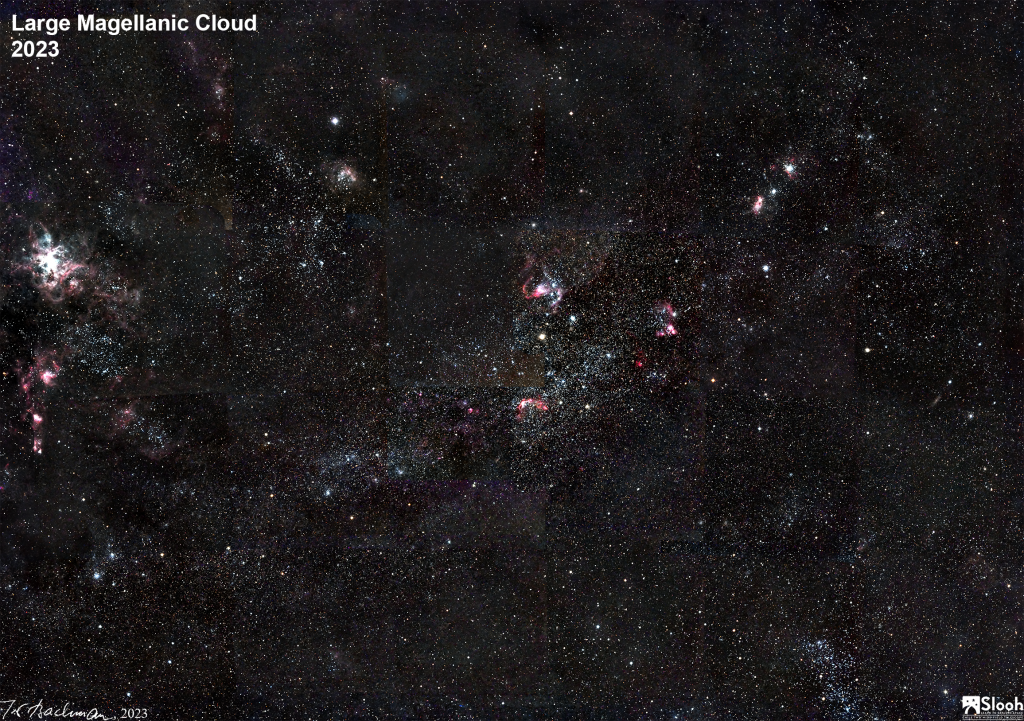
Finally I compared different mosaic assembly options. There are multiple ways to blend and equalize panels; for this project I chose the version I could control most reliably.
You can always push processing further, but at some point it’s wise to stop. My final view of the Large Magellanic Cloud is fairly dark, with only a modest “cloudiness” left — but the overall structure remains clear without forcing the background unnaturally bright.