The English astronomer Sir Patrick Caldwell Moore (1923–2012) is well known as the long‑time host of the BBC series The Sky at Night, which he presented for over 40 years.
Because the Messier catalogue is strongly biased toward the northern sky, Moore created the Caldwell catalogue: 109 deep‑sky objects that are (in his view) attractive and accessible to amateurs. Many are excellent targets for observers in the southern hemisphere.
During the pandemic, when travel restrictions and social distancing limited everyday life, I found astrophotography an especially fruitful hobby. Collecting the Caldwell objects became a long but rewarding project for me.
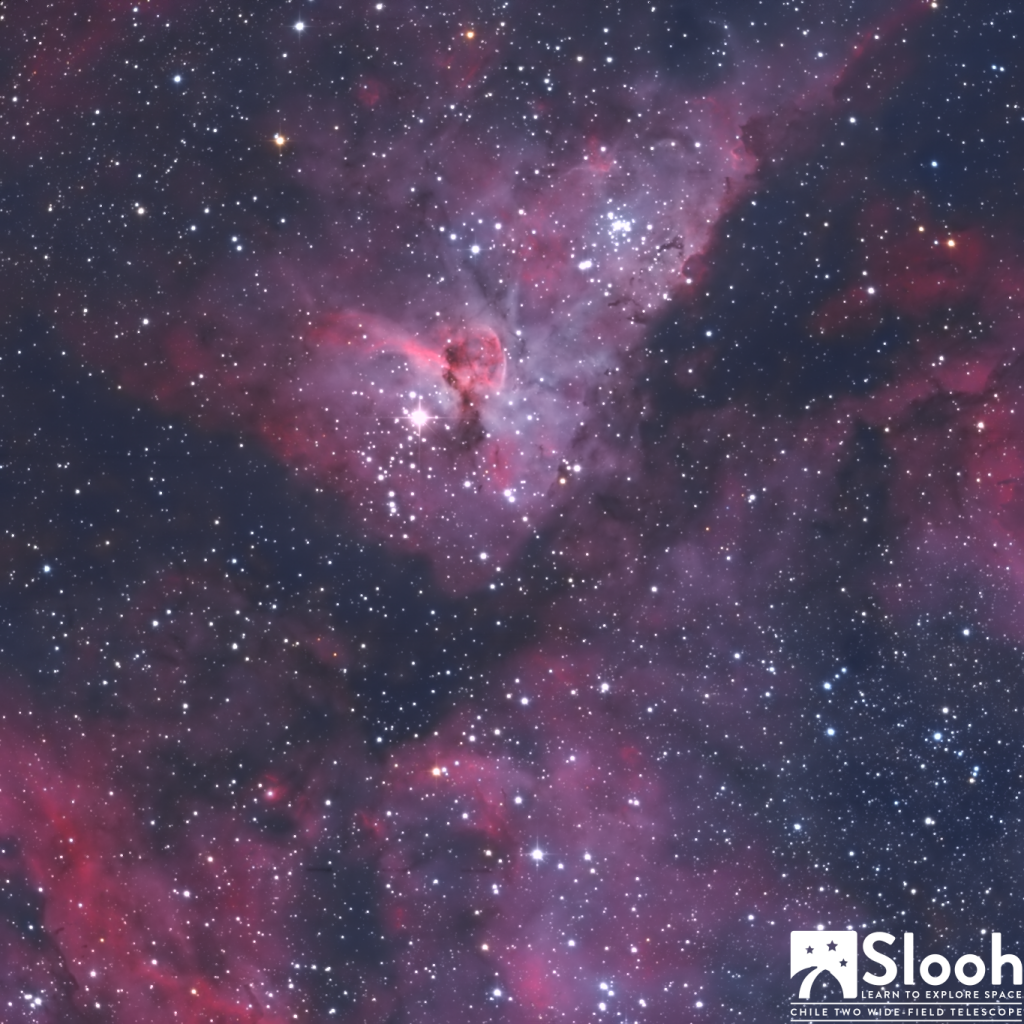
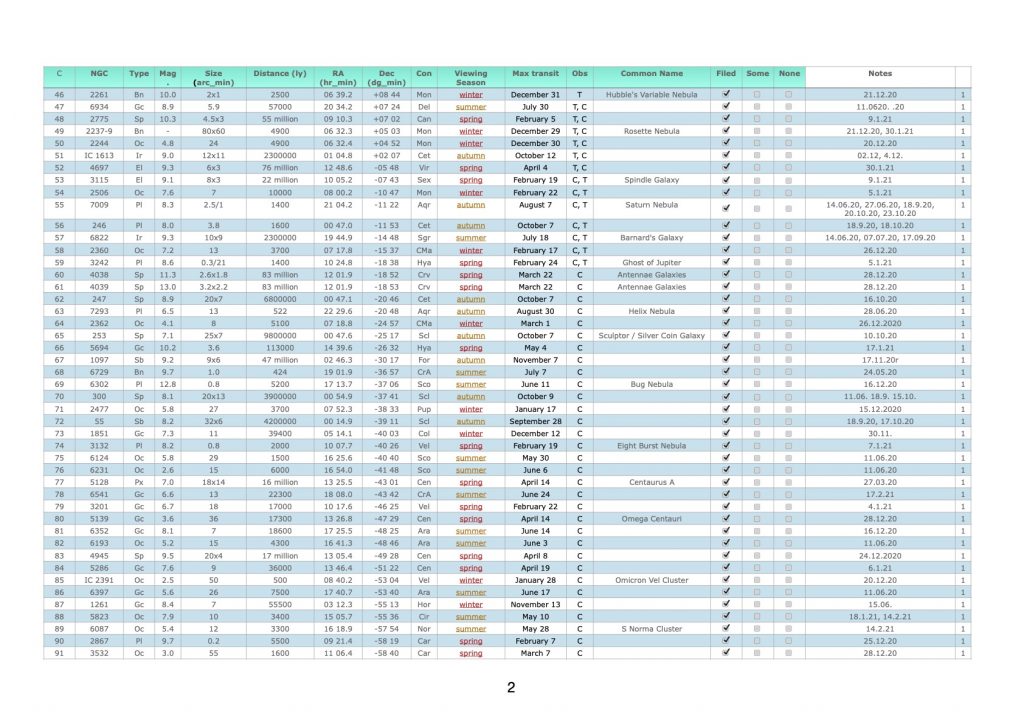
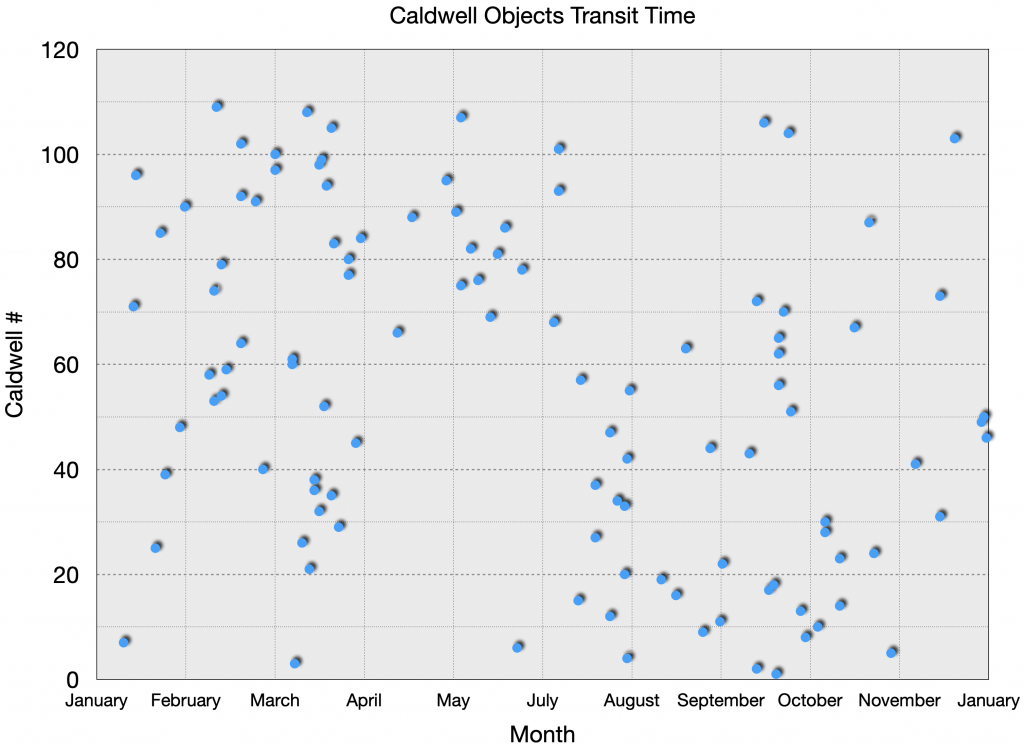
However, I had the opportunity to collect all the objects from Slooh's Canary or Chilean observatories. For the purpose of collecting, I created a database in which I marked all the objects, the time they were highest in the sky and when I had photographed them. The database helped me keep track of the situation better than the Post-it method I used with the Messier objects. The objects are conveniently numbered, with C1 being the northernmost and C109 being the southernmost. The database image also shows that after object C51 we move to the southern hemisphere, so the objects are evenly distributed in the starry sky.
I started the project in March 2020 and captured the final targets in 2021. In practice the project stretched to well over a year because you can only image each object during a limited season — and of course only when there are clear nights and available slots.
In Slooh I can typically reserve five imaging slots per night. For most targets I used four exposures: one unfiltered (L) and three through red, green and blue filters (RGB). This gives a natural‑color result while keeping the workflow manageable.
During the pandemic, servicing and maintenance of the equipment was affected by travel restrictions. Occasionally this showed up as partial hardware issues, which in turn could cause star shapes or tracking to be less than ideal. Still, the overall data quality was excellent and I was able to complete the collection.
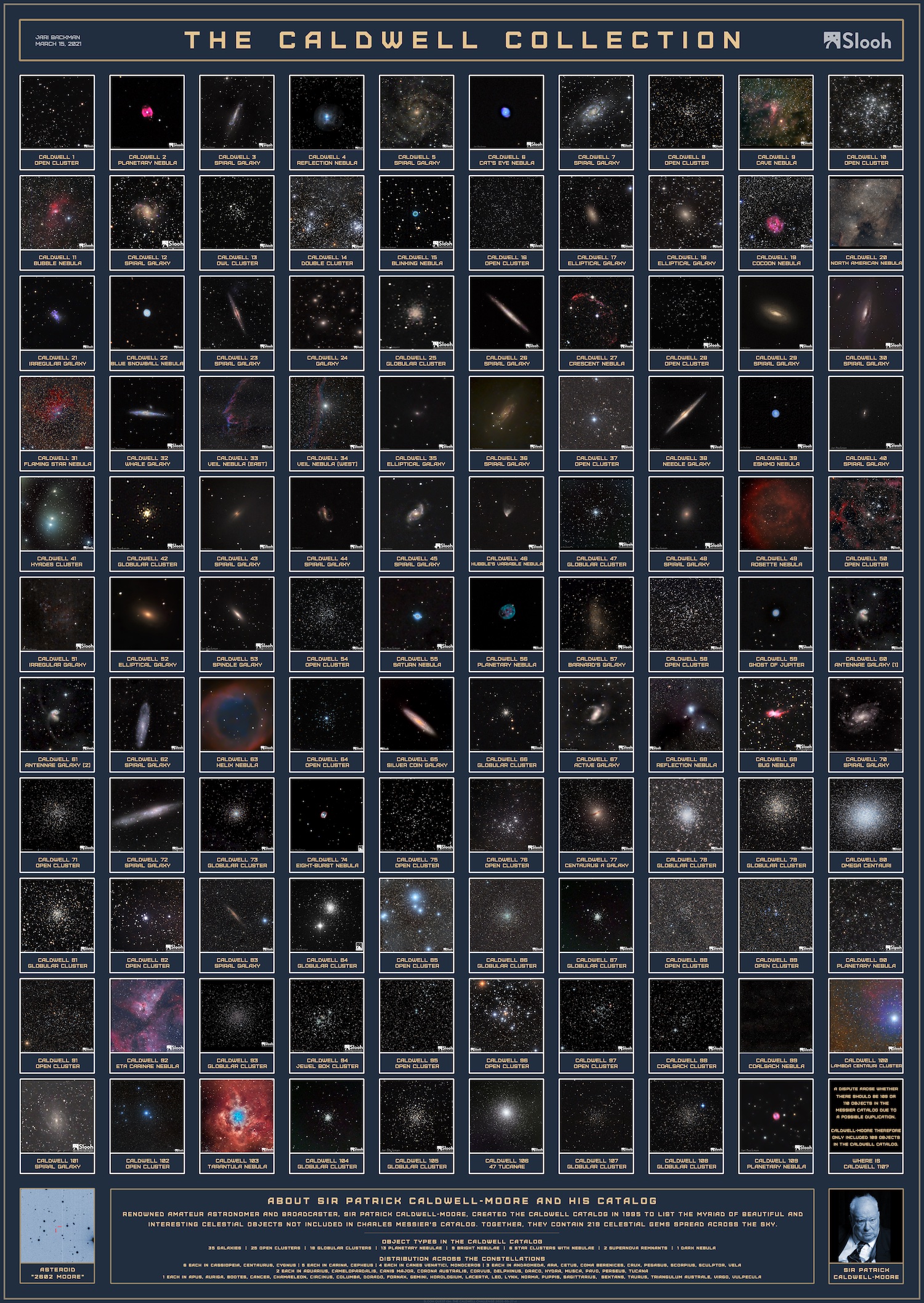
Because the Caldwell objects are also one of Slooh’s observing “quests”, I was able to order a high‑quality poster from my images.
I also made a short YouTube video where the objects can be seen even more clearly.
Collecting the Caldwell catalogue was extremely interesting — and at times demanding. It required systematic work, careful planning, and patience. Looking back, I’m proud of what I accomplished: not only did I image every target, the project also deepened my understanding of the night sky.
Sir Patrick Moore was a passionate popularizer of astronomy. His work — and the Caldwell catalogue — will remain a lasting tribute to him.