In Yle Areena’s 2015 podcast series History of Astronomy, Tapio Markkanen mentions that in 1761 and 1769 Anders Planman, a professor at the Royal Academy of Turku, travelled on expeditions to observe the transit of Venus and, in connection with those journeys, determined the geographic coordinates of several locations in Finland.
The previous articles in this series explain how latitude and longitude were determined 260 years ago; it is worth reading them before diving into this one. Here we finally take a look at the transits of Venus in the 1760s.
Distance to the Sun — astronomy’s yardstick
Based on Kepler’s work, already in the 1600s it was possible to compute the relative distances in the Solar System as ratios to the Earth–Sun distance (the astronomical unit, AU). But the absolute scale — the actual kilometre distance — could only be guessed. In his studies, Kepler proposed using a transit of Venus to determine the Sun’s distance.
A transit of Venus occurs when Venus passes between Earth and the Sun so that, from Earth, it is seen crossing the solar disc. Because of the geometry of the two orbits, transits are rare and happen in a distinctive four‑part cycle: 105.5 years, 8 years, 121.5 years, and 8 years.
After Kepler’s proposal, the next transit in 1631 was not visible in Europe, but in 1639 James Horrocks estimated the solar parallax as 14″. That would imply a Sun–Earth distance of about 94 million kilometres — a bit under two‑thirds of the true value.
This article focuses on the transit pair of 1761 and 1769. Fifty years earlier, Edmond Halley (1716) had proposed determining the solar parallax from the duration of the transit as measured from widely separated locations. In his time the parallax was often assumed to be about 12.5″.
The parallax idea is illustrated in the figure below: from a more northerly site, Venus appears to follow a slightly lower track across the Sun than from a more southerly site. The full transit lasts roughly six hours, but the duration differs between sites by a few minutes up to about ten minutes. Halley therefore urged observers to spread out as widely as possible across Earth wherever the transit was visible.
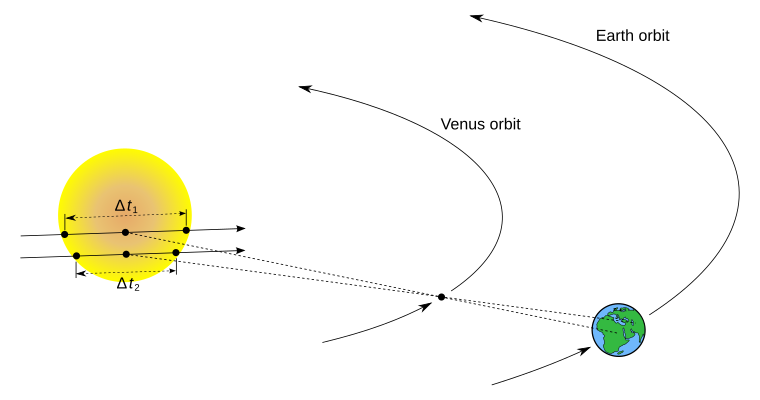

In Paris in 1760, the French astronomer Jean‑Nicolas Delisle proposed a parallel method. Unlike Halley’s approach, it required recording the exact time of a single internal contact from two sites whose latitude and longitude were known accurately. In that framework, observing either the second or third contact could suffice; it was no longer necessary to observe both ingress and egress, as Halley’s method required.
Space probes have since determined the mean value of the Sun’s parallax as 8.794 arcseconds. For measurements, the word “mean” matters: because Earth’s orbit is elliptical, the parallax varies between about 8.944″ and 8.650″. It is largest in early January and smallest in early July. Astronomers, however, have traditionally reduced their results to the mean value.
Transit of Venus — 6 June 1761
While the 1639 transit was observed only at two sites in England, by 1761 telescopes were ready at more than 80 locations in roughly two dozen countries.
The Royal Swedish Academy of Sciences responded by organizing observations at ten sites. Reports were published promptly in the Academy’s proceedings, from Stockholm, Uppsala, Kajaani, Turku, Härösund, Kalmar, Karlskrona, Lund, Landskrona and Tornio. /1/
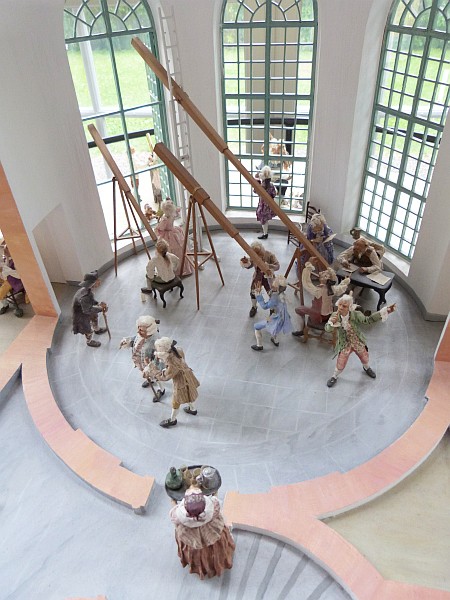
Pehr Wargentin’s overview of the Swedish observations is an excellent account. The Stockholm Observatory scene
in particular surprises the reader. Wargentin writes that when the event began:
“Mr Lecturer WILCKE observed with a two‑foot reflecting telescope. Smaller tubes were also provided to Major
Baron von SETH, the Royal Order’s archivist, Dr GADOLIN, Professor LEHNBERG and C. LEHNBERG; but the room
did not allow them all to be near the clock, since it was necessary to hear the one who counted the seconds
aloud.”
In June, getting the full six hours of visibility is most favourable at high northern latitudes. Planman’s
original plan was therefore to observe in Finnish Lapland. But in the 1700s, as today, circumstances could
reshape travel plans. Planman describes his journey vividly:
“I set out with the necessary equipment on February 2 and reached Turku later that month, having
successfully overcome the hazards of sea travel. From there I travelled straight through Finland. It is hard
to say how much delay the snow caused: it often rose to 1.2 metres; the horses were up to their backs in
water, as the surface softened in the spring warmth. I often had to force my way on horseback, especially
through forests. Having thus lost hope of reaching the farthest parts of Lapland, I decided to reach
Kajaaninlinna by all means and had the instruments carried by manpower. When the forests were extensive and
we walked, I was often sunk in snow up to my arms, and could not get free without the help of others. At
last, on April 14, I arrived at Kajaaninlinna.”
When I have used Nova’s club telescopes, even ordinary target tracking can succeed with varying ease. So how on Earth could the Sun be kept in view for hours with a tube over six metres long? In observatories such as Stockholm (though not clearly shown in the model above), telescopes could be mounted on movable supports and guided with block‑and‑tackle around their balance point. But how did Planman manage in the field while travelling to northeastern Finland? He answers in his dissertation:
“To observe the different contacts I used an instrument whose objective focal length was 21 Swedish feet and the eyepiece two and a half inches. Its support was arranged so that the front could be raised gradually by means of pulleys at the observer’s request, while the rear needed only to be directed horizontally along the Sun’s motion. Thus arranged, the Sun did not disappear from my field even in the blink of an eye. To diminish the Sun’s power I used two reddish glasses; I used the lighter one for contacts 2 and 3 so that the thinnest thread of the solar limb would appear more clearly. I also remind you that I have trained both my left and right eye for observations: with one eye I could take micrometer readings and with the other the contact moments, so that the eye that had watched the Sun for hours would not lose the ability to detect precisely the beginning and end of the contacts.”
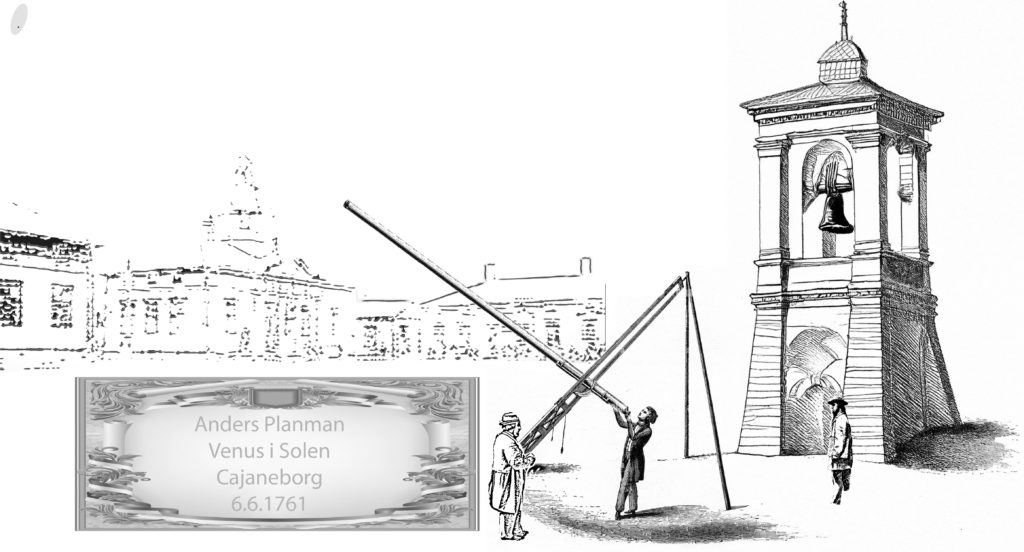
After reading this, one can only raise one’s hat to Planman. In Stellarium you can check how demanding timing the transit really was. For the six‑hour duration he obtained a result that differed by only three seconds.
Planman succeeded in observing all four contacts. If another observer elsewhere also had complete timings, the distance to the Sun could, in principle, be computed. Results did come in — but not in a completely unambiguous way.
Planman presented his results in his 1763 dissertation /2/. In the same spirit, and also in the Swedish Academy proceedings /3/ a few months later, he proposed a solar parallax of 8.2″.


Planman also describes clearly the “black strip” seen between Venus and the solar limb. The critical moments were when the thin sliver of sunlight appeared as Venus moved fully onto the Sun at ingress, and when Venus seemed to “stick” to the solar limb at egress. In those moments the optical black drop effect made the edges of Venus and the Sun appear less sharp. Because many sites had multiple observers, to everyone’s surprise differences of even tens of seconds were recorded despite using the same timekeeping. James Short reported that at ten locations with multiple observers, the average difference exceeded six seconds. /4/
The quality of geographic coordinates in the 1700s varied and was a significant contributor to the scatter in results. Longitude in particular was often poorly known. For example, the “known” position of the Prince of Wales Fort on Hudson Bay in Canada was off by about 25 kilometres.
Observing was further complicated by primitive solar filters and chromatic errors in refracting telescopes. Planman also discovered afterwards that a one‑minute error had crept into the clock after the egress phase had begun.
He noted that his value was two seconds smaller than that found by de La Caille at the Cape of Good Hope in 1750. A year later Planman refined his calculations and obtained a solar parallax of 8.25″. /5/
In December 1763, the English astronomer James Short compared about 20 observations /6/ and obtained a mean of 8.56″. Short also noticed Planman’s one‑minute timing error, which had also occurred in the Turku observations.
Astronomy requires dedication — but the Frenchman Guillaume Le Gentil de la Galaisière raised the bar to an extreme. He set out in March 1760 for Pondicherry in India, but war between England and France made the journey difficult and, suffering from dysentery, he turned toward Madagascar. He missed the transit by a few weeks and decided to remain in the region to await the 1769 event. The eight‑year wait was filled with expeditions, star mapping, and battles with illness, yet the hope of a successful second attempt kept him going — a true “once‑in‑a‑lifetime” attitude.
Transit of Venus — 3 June 1769
Wiser from the earlier experience, observers set out again eight years later. Although there were more potential observers, the Swedish Academy chose to invest more in quality than in sheer quantity, and equipped six observing stations with more experienced teams. Worldwide, Captain James Cook, for example, was tasked with observing the transit during his Pacific voyage.
The visibility of the full transit was concentrated over the Pacific region and the northern parts of Earth, so many sites had to settle for partial observations — if the weather cooperated.

After his dissertation, Anders Planman was appointed professor at the Royal Academy of Turku in 1763. He travelled again to Kajaani. The trip nearly became a fiasco: on 3 June the sky was cloudy and at midday it was impossible to verify local solar time. But as the transit began, the cloud cover opened and Planman was able to time the moment when Venus was fully inside the Sun. He also measured the altitudes and azimuths of Venus and the Sun with the theodolite. Then clouds returned and a thunderstorm worsened the situation. The sky cleared partly at egress, allowing Planman to interpolate the moment when the Venus disc (still on the Sun) touched the solar limb. Although observers were prepared for the black‑drop effect, Planman’s assistant recorded a time differing by three seconds. /7/, /8/
Results were again obtained, but weather, observing technique and the limitations of the equipment still produced scatter. Converting transit timings into a parallax is not simple, and even when all observations were considered, different analyses produced different answers. Reported values ranged between 8.43″ and 8.80″.
Longitude errors were still a problem: in Euler’s calculations, for example, the position of the Prince of Wales Fort on Hudson Bay was about 25 km wrong.
In nearby Saint Petersburg, one of science’s great names, Leonhard Euler, assigned the parallax computation to his young assistant Anders Lexell. /9/, /10/, /11/ Lexell’s work sparked a major controversy involving several respected astronomers.
Lexell obtained 8.68″; Hell 8.7″; Lalande 8.5″ or 8.6″; and Planman 8.43″. Apparently the main cause of disagreement was Lexell’s assessment of which observations were reliable, rather than the numerical values themselves.
The 1769 results continued to be re‑analysed long afterwards. Johann Encke derived 8.5776″ in 1824. In 2004 François Mignard computed, from all observations of the durations between contacts 2 and 3, an average of 8.61″.
Since historically the derived parallax tended to decrease over time, one might, with hindsight, think that Planman — who obtained one of the lowest values — could have felt he was “leading the race”. He simply did not realize that the true value had already been passed.
Returning to Guillaume Le Gentil: after we left him waiting for the 1769 transit, he was ready for his second attempt in Pondicherry. He had built careful observing arrangements and prepared thoroughly — but on transit day the sky clouded over at exactly the decisive moment. After eleven years away, he returned to France in 1771 only to discover that he had been officially declared dead, his wife had remarried, and his property and position had been distributed to others. Sometimes an astronomer’s greatest trial is life itself.
Summary of the article series
This is a good point to summarize my own “digging into old things” this summer. I did not write down the start date, but on 19 June I created a “Planman” folder on my computer, so perhaps this began in early June.
At first, the plan was simply to tell about Planman’s journeys. Then I started doing the computations myself and ended up in the deep end. Along the way I also learned a great deal about the sextant — but Planman’s and his contemporaries’ publications opened an even more fascinating world.
I do not claim that I previously underestimated 18th‑century astronomers — after all, Eratosthenes, Tycho Brahe, Kepler, Galileo and Newton laid the foundations of modern knowledge. But on this journey my appreciation grew enormously.
As a closing note, there may still be a fourth article: in recent weeks I have been circling around the parallax calculations. I have learned a lot there too, but starting from a weaker theoretical base it is still difficult. It may remain so — so I promise nothing.
Sources
[1] Wargentin, Pehr. OBSERVATIONER På Planeten Veneris gång genom Solens Discus, om äro gjorde i Stockholm, Upsala, Åbo, Carlscrona, Lund, Landscrona, Cajaneborg den 6 Junii 1761 . Kungliga Svenska Vetenskapsakademiens Handlingar, April, May and June 1761, pp. 143–166.
[2] Planman, Anders. DISSERTATIO DE VENERE IN SOLE VISA DIE 6 JUNII ANNI 1761 , Planman’s dissertation, 23 Feb 1763, Royal Academy of Turku, 1763.
[3] Planman, Anders. Solens Parallaxis , Kungliga Svenska Vetenskapsakademiens Handlingar, April, May and June, pp. 118–134.
[4] Short, James. The observations of the internal contact of Venus with the Sun’s limb, in the late transit, made in different places of Europe... , Philosophical Transactions of the Royal Society, December 1762, pp. 611–628.
[5] Planman, Anders. Ytterliga uträkningar på Solens Parallaxis... , Kungliga Svenska Vetenskapsakademiens Handlingar, April, May and June, pp. 139–142.
[6] Short, James. Second paper concerning the parallax of the sun determined from the observations of the late transit of Venus... , Philosophical Transactions of the Royal Society, December 1762, pp. 300–345.
[7] Planman, Anders. Venus i Solen den 3. Junii 1769, Kungliga Svenska Vetenskapsakademiens Handlingar, July, August and September 1769, pp. 214–218.
[8] Planman, Anders. Expositio observationum transitus Veneris per solem, Cajaneburgi a:o 1769 D. 3 Junii factarum , Master’s presentation at the Royal Academy of Turku, 1770. (In the 1700s the Master’s degree included presenting a dissertation written by the professor.)
[9] C. Sten, P.P. Aspaas. Anders Johan Lexell’s Role in the Determination of the Solar Parallax , Journal of Astronomical Data, 2013.
[10] Lexell, Anders. Uträkning över solens parallaxis... , Kungliga Svenska Vetenskapsakademiens Handlingar, July, August and September 1771, pp. 220–234.
[11] Lexell, Anders. Uträkning öfver solens parallax... , Kungliga Svenska Vetenskapsakademiens Handlingar, July, August and September 1771, pp. 301–330.